











Organizations that rely solely on historical reporting struggle to maintain competitive advantage in rapidly changing markets. Executives and operations teams require visibility into future possibilities, not just past performance. AI for predictive analytics delivers this forward-looking capability by synthesizing historical data, statistical modeling, and machine learning to forecast outcomes and identify opportunities before they materialize.
Recent data shows that 78% of organizations have integrated AI into at least one business function, a significant leap from the 55% reported just one year prior.
Modern businesses generate unprecedented volumes of data daily. The challenge lies not in data availability but in extracting meaningful insights that inform strategic decisions. AI-driven insights transform this raw information into predictive intelligence, enabling companies to anticipate customer behavior, optimize resource allocation, and proactively address emerging risks.
The global predictive analytics market is on a trajectory to exceed $78.59 billion by 2032, more than quadrupling its 2024 valuation of $18.79 billion. This growth includes a significant $22.14 billion surge in 2025 alone, maintaining a strong compound annual growth rate (CAGR) of 22.5% through the end of the decade.
This article explores how AI-powered predictive analytics is reshaping decision-making across industries, the core technologies behind it, and real-world applications delivering measurable value.
What is AI-Powered Predictive Analytics?
Predictive analytics employs historical data, statistical techniques, and machine learning models to estimate the probability of future events. Rather than describing what already occurred, this approach answers critical business questions such as which customers face the highest churn risk, what demand patterns will emerge next quarter, or which transactions show fraudulent characteristics.
Traditional predictive models depended heavily on classical statistics and manual feature engineering. Modern AI enhances predictive analytics by applying machine learning models capable of capturing complex, nonlinear patterns in large, high-dimensional datasets that are difficult to model with traditional approaches alone. These AI-driven models learn directly from data instead of relying exclusively on predefined formulas, improving both accuracy and adaptability.
The distinction between standard predictive analytics and AI-powered approaches centers on capability and automation. Traditional predictive analytics leans on methods such as regression analysis, data mining, and modeling, requiring human intervention and analysis at each step. AI amplifies this process through machine learning algorithms that continuously refine predictions based on new data, enabling real-time decision-making and autonomous pattern detection across massive datasets.
Core Components of AI Predictive Analytics Systems
Successful AI predictive analytics implementations share several foundational elements that function together as an integrated pipeline.
Data Foundation and Preparation
Predictive models depend on historical data capturing relevant signals about forecasted outcomes. This encompasses transactional records, customer interactions, behavioral patterns, operational logs, sensor readings, and external market indicators. Comprehensive data collection, cleaning, integration, and feature engineering ensure models learn from accurate, consistent inputs.
Data quality, completeness, and representativeness often matter more than model complexity. Organizations operating with incomplete, inconsistent, or inaccurate data will produce unreliable predictions, regardless of the algorithms employed. The preparation phase involves removing inaccuracies or inconsistencies and transforming information into formats suitable for model consumption.
Machine Learning Architecture
Predictive models take multiple forms depending on problem requirements. Regression models address continuous outcomes like revenue forecasts, while classification algorithms handle discrete results such as churn probability. Time series models process sequential data, and ensemble methods combine multiple algorithms for enhanced performance.
Modern AI systems frequently employ gradient boosting, random forests, deep neural networks, or specialized architectures for text, images, and sequential information. Model selection depends on problem characteristics, data attributes, interpretability requirements, and available expertise. Well-tuned, moderately complex models often outperform overly sophisticated architectures that prove fragile and difficult to maintain in business environments.
Deployment Infrastructure and Monitoring
Once trained and validated, models require deployment into production environments generating predictions on new data in real time or batch mode. Integration with analytics dashboards, CRM platforms, marketing systems, and operational tools ensures predictions influence actual decisions rather than remaining isolated in experimental notebooks.
Effective implementations incorporate monitoring systems tracking model performance over time, detecting drift, and triggering retraining when accuracy deteriorates due to changing data patterns or market conditions. This continuous oversight maintains prediction quality as business environments evolve.
Strategic Advantages of AI-Driven Predictive Analytics
Organizations implementing AI for predictive analytics realize multiple strategic benefits that compound over time.
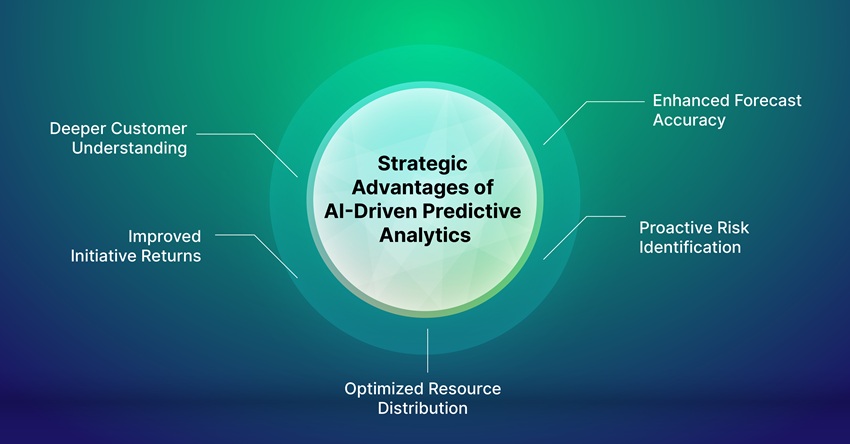
Enhanced Forecast Accuracy
AI models capture intricate patterns and nonlinear relationships within data, improving forecast precision over traditional methods. This reduces costly overestimation or underestimation across demand planning, financial projections, and resource allocation.
Proactive Risk Identification
Predictive analytics flags potential issues early, including churn risk, credit exposure, fraud probability, and operational failures. Teams can implement preventive interventions rather than reactive responses, substantially reducing negative impact.
Optimized Resource Distribution
Demand and workload forecasts enable more efficient allocation of inventory, staffing, and capital. Organizations reduce waste while improving service levels across operations through data-informed resource decisions.
Improved Initiative Returns
Predictive models focus commercial and operational efforts on high-probability opportunities such as conversion-ready leads or at-risk customers. This targeting improves return on investment for marketing campaigns, customer success initiatives, and sales activities.
Deeper Customer Understanding
AI identifies behavioral patterns and micro-segments that traditional analysis overlooks. These insights support more precise personalization and lifecycle management strategies, strengthening customer relationships and increasing lifetime value.
While predictive analytics delivers strong business value, organizations often face implementation and data-related challenges.
A Practical Step-by-Step Guide to Deploy AI Predictive Analytics
Deploying AI predictive analytics requires a structured methodology addressing strategy, data, technology, and change management simultaneously.
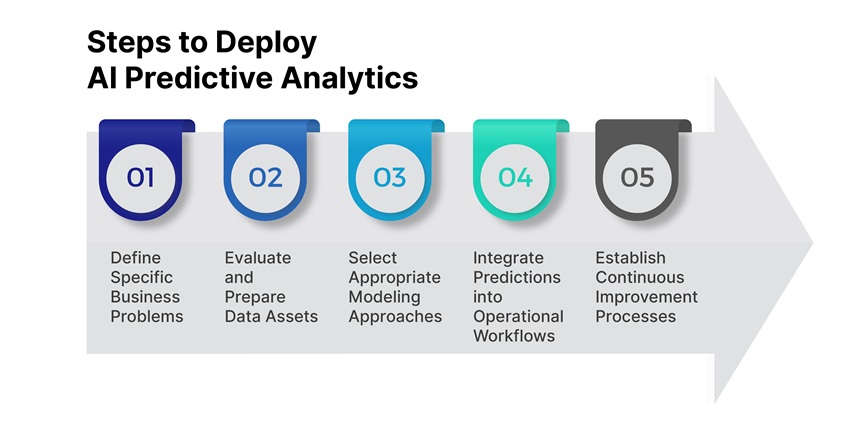
1. Define Specific Business Problems
Begin with high-value, well-framed questions rather than generic AI initiatives. Clear problem statements guide data selection, model design, and success metrics. Examples include identifying small business customers likely to churn within 90 days, determining which invoices face late payment risk, or predicting maintenance tasks preventing the most downtime.
2. Evaluate and Prepare Data Assets
Identify relevant data sources for defined problems, including CRM records, transactional logs, usage metrics, survey responses, and external indicators. Invest in data integration and cleaning to address missing values, inconsistent formats, and duplicates. Feature engineering transforming raw data into meaningful inputs often produces greater gains than switching to more complex models.
3. Select Appropriate Modeling Approaches
Choose models suited to problem characteristics. Regression addresses continuous outcomes, classification handles probabilities, and time series approaches process sequential data. For many tabular business problems, well-tuned gradient boosting or regularized regression models perform extremely well and are easier to interpret and maintain than deep learning alternatives.
Split data into training, validation, and test sets for honest performance evaluation. Assessment should consider raw accuracy alongside precision, recall, calibration, and business impact measures tied to costs and benefits of prediction outcomes.
4. Integrate Predictions into Operational Workflows
Prediction scores should be embedded in decision points, whether in CRM interfaces, planning tools, ticketing systems, or custom dashboards. Define action rules around thresholds and ensure front-line teams understand score interpretation and application.
Effective integration ensures analytical outputs support daily activities and inform strategic decisions.
5. Establish Continuous Improvement Processes
Monitor model performance continuously against statistical metrics and business KPIs after deployment. Data distributions change due to new products, market shifts, and evolving customer behavior, causing model drift. Create processes for periodic retraining, backtesting, and experimentation maintaining or improving performance over time.
Predictive Analytics Applications Across Industries
AI-powered predictive analytics supports strategic and operational decisions across diverse sectors.
Customer Retention and Churn Management
Organizations analyze contract histories, product usage patterns, support interactions, payment behavior, and engagement signals to estimate which customers face the highest churn probability within specific timeframes. Commercial and customer success teams prioritize retention campaigns and targeted outreach for high-risk accounts instead of applying generic measures across entire customer bases.
Integrating churn scores directly into CRM systems ensures front-line teams access predictions within their daily workflows, translating analytical insights into preventive action.
Demand Forecasting and Inventory Optimization
Retailers, manufacturers, and logistics providers employ AI models forecasting product demand at granular levels by SKU, location, channel, and segment. These forecasts account for seasonality, promotional calendars, macroeconomic factors, and historical trends. Improved accuracy supports optimized purchasing, production planning, and inventory allocation, simultaneously reducing stockouts and overstock costs.
Financial Risk and Fraud Detection
Financial organizations use AI predictive analytics to identify unusual patterns indicating fraud across multiple contexts. Models analyze transaction sequences, account access patterns, payment behaviors, and entity relationships to detect anomalies that warrant further investigation. Suspicious events trigger additional verification, transaction holds, or enhanced monitoring, reducing fraud losses while minimizing disruption for legitimate activity.
Similar approaches support credit risk assessment, underwriting decisions, and collections prioritization. AI models incorporate alternative data sources including payment history across multiple accounts, employment stability indicators, and transaction patterns, providing more comprehensive risk profiles than traditional credit scores alone. These methods enable more accurate risk stratification and appropriate pricing or control decisions.
Predictive Maintenance Programs
Asset-intensive industries including manufacturing, energy, and transportation analyze sensor data, maintenance logs, and operational conditions to predict equipment failures before occurrence. Maintenance teams plan interventions proactively, reducing unplanned downtime, extending asset lifespan, and optimizing spare-part inventories.
This predictive capability typically integrates with existing operational systems, and is accessible via specialized dashboards for plant managers and field engineers.
Emerging Predictive Analytics Trends Shaping the Future
Several innovations expand the capabilities and accessibility of AI predictive analytics.
Automated Machine Learning Platforms
AutoML platforms are making predictive analytics accessible to non-technical users by automating feature selection, model training, and hyperparameter tuning. These tools reduce the time and specialized expertise required to develop AI-driven predictions, democratizing advanced analytics across organizations.
Explainable AI for Trust and Compliance
As AI-driven predictions impact critical business decisions, there is a growing need for explainable AI models providing transparency into how predictions are made. Techniques including SHAP values and LIME help stakeholders understand model reasoning, particularly important in regulated industries where prediction justification carries legal or compliance implications.
Real-Time Processing Capabilities
The proliferation of IoT devices and edge computing enables AI-driven predictive analytics processing data in real time. Businesses respond immediately to market fluctuations, cybersecurity threats, and operational inefficiencies rather than waiting for batch processing cycles.
Natural Language Processing Integration
AI-powered NLP models transform predictive analytics in finance, healthcare, and customer service domains. Sentiment analysis, conversational AI, and market predictions derive insights from unstructured data including social media posts, news articles, and customer feedback that traditional methods cannot effectively process.
While these trends make predictive analytics more powerful and widespread, they also introduce new responsibilities. As AI predictions affect people, finances, and operations, governance and ethical considerations become essential to ensure trust, fairness, and long-term success.
Governance and Ethical Considerations
AI predictive models influence decisions affecting customers, employees, and investments. Without appropriate governance frameworks, they introduce risks around bias, fairness, privacy, and accountability.
Transparency and Interpretability Requirements
Stakeholders increasingly expect understanding of why models generated particular predictions, especially in regulated environments. Techniques like feature importance analysis, partial dependence plots, and surrogate models help explain complex algorithms in accessible terms. Some contexts favor simpler, more interpretable models over black-box approaches despite small accuracy trade-offs.
Bias Detection and Fairness Testing
Historical data often encodes societal and organizational biases. AI models trained on such data may reinforce disparities, for example predicting lower creditworthiness for certain demographic groups because of past discriminatory patterns. Organizations must test models for disparate impact across groups, ensure regulatory compliance, and establish principles for responsible AI deployment.
Privacy Protection and Security
Predictive analytics frequently employs sensitive personal, behavioral, or financial information. Compliance with privacy frameworks requires careful data minimization, purpose limitation, anonymization or pseudonymization where appropriate, robust access controls, and transparent communication with data subjects about information usage.
Conclusion
AI for predictive analytics represents a fundamental shift from reactive to proactive decision-making. Organizations leveraging these capabilities gain competitive advantages through improved forecast accuracy, proactive risk management, optimized resource allocation, and deeper customer insights.
Success requires more than technical implementation alone. It demands clear business objectives, robust data foundations, thoughtful model design, careful workflow integration, and commitment to continuous improvement and responsible governance.
As AI technologies continue advancing and becoming more accessible, organizations that embed predictive capabilities strategically will differentiate themselves through superior anticipation and response to market opportunities and challenges.